
Let’s Be Honest about the Impacts of HOME
You know what I hate? I hate it when city officials and politicians aren’t honest and don’t talk straight about the effects of their policies. Awhile back, I posted a reel about how some Austin politicians are taking credit for the moderation in rents in the last year, claiming that their zoning reforms are the cause of a decrease in rents recently. I talked about why that isn’t so.
Well, we’re seeing it again, this time regarding a report from the Development Services Department assessing the impacts of the HOME initiative after its first year of implementation.
Some of our city leaders are citing the report to claim that the HOME initiative is a big success, adding supply, preserving naturally affordable housing, and avoiding a wave of demolitions.
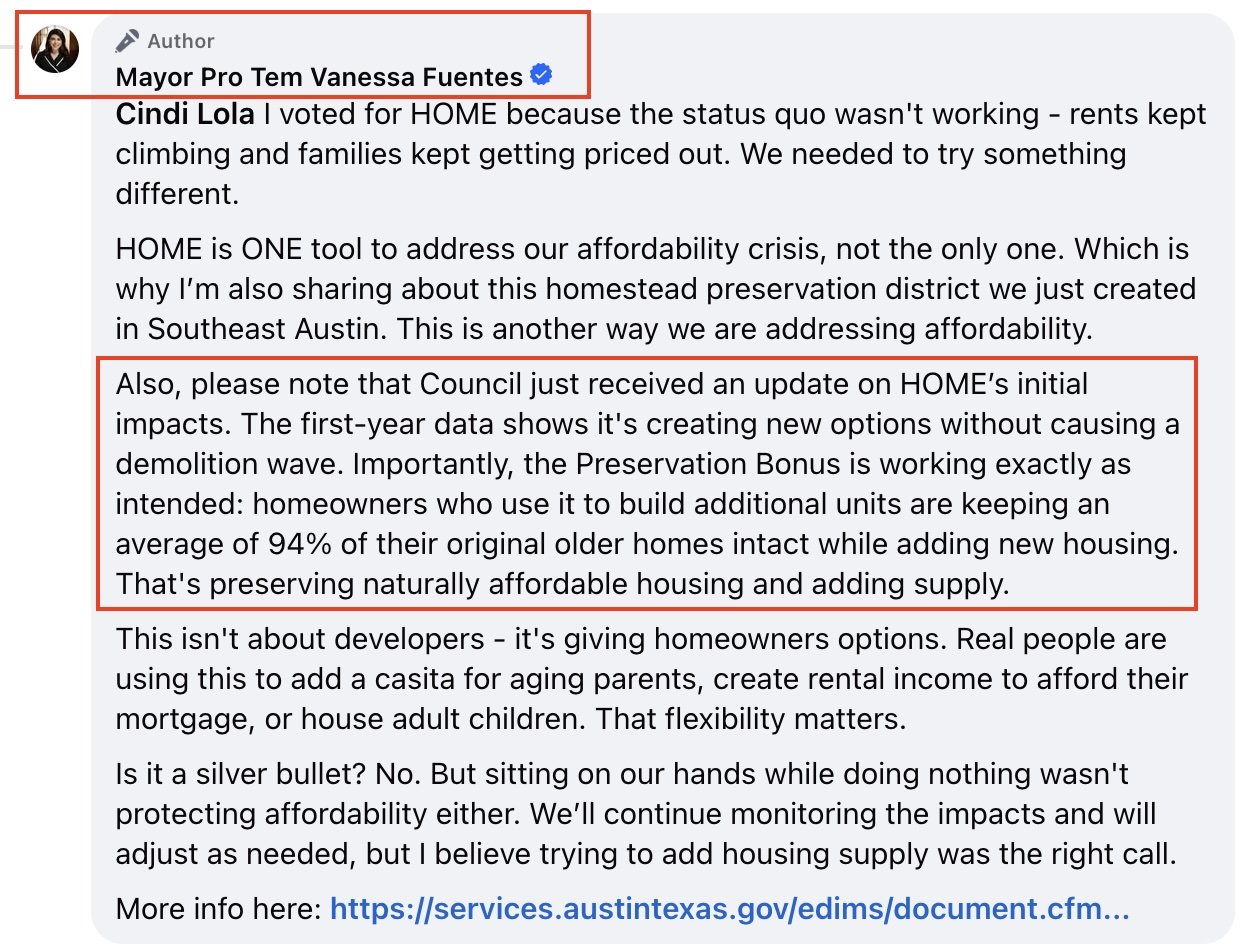
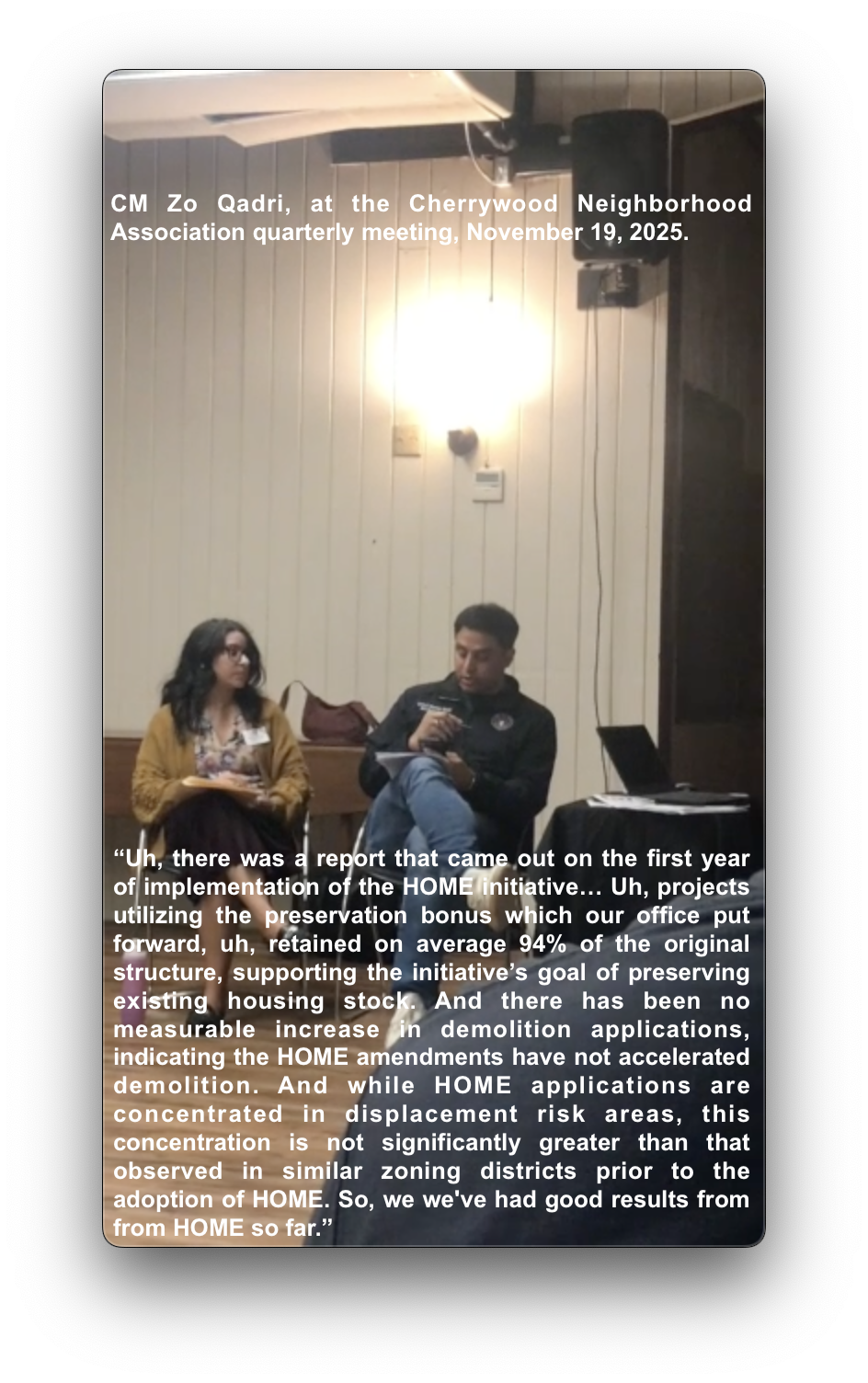
To be fair, that is what the report says. However, I actually read the details of the report and looked at the data it analyzes. Turns out, the report itself is misleading, spinning the data into a success story, when in reality, HOME has made demolitions more common in infill projects,[1] has shifted development more towards neighborhoods vulnerable to displacement, and has not incentivized the preservation of affordable housing. In fact, part of the report actually undermines the primary argument used by proponents of HOME, that zoning is a major barrier to housing construction.
[1] “infill” refers to projects in already developed parts of the city, rather than new subdivisions and developments on the outskirts of the city.
Did HOME increase demolitions?
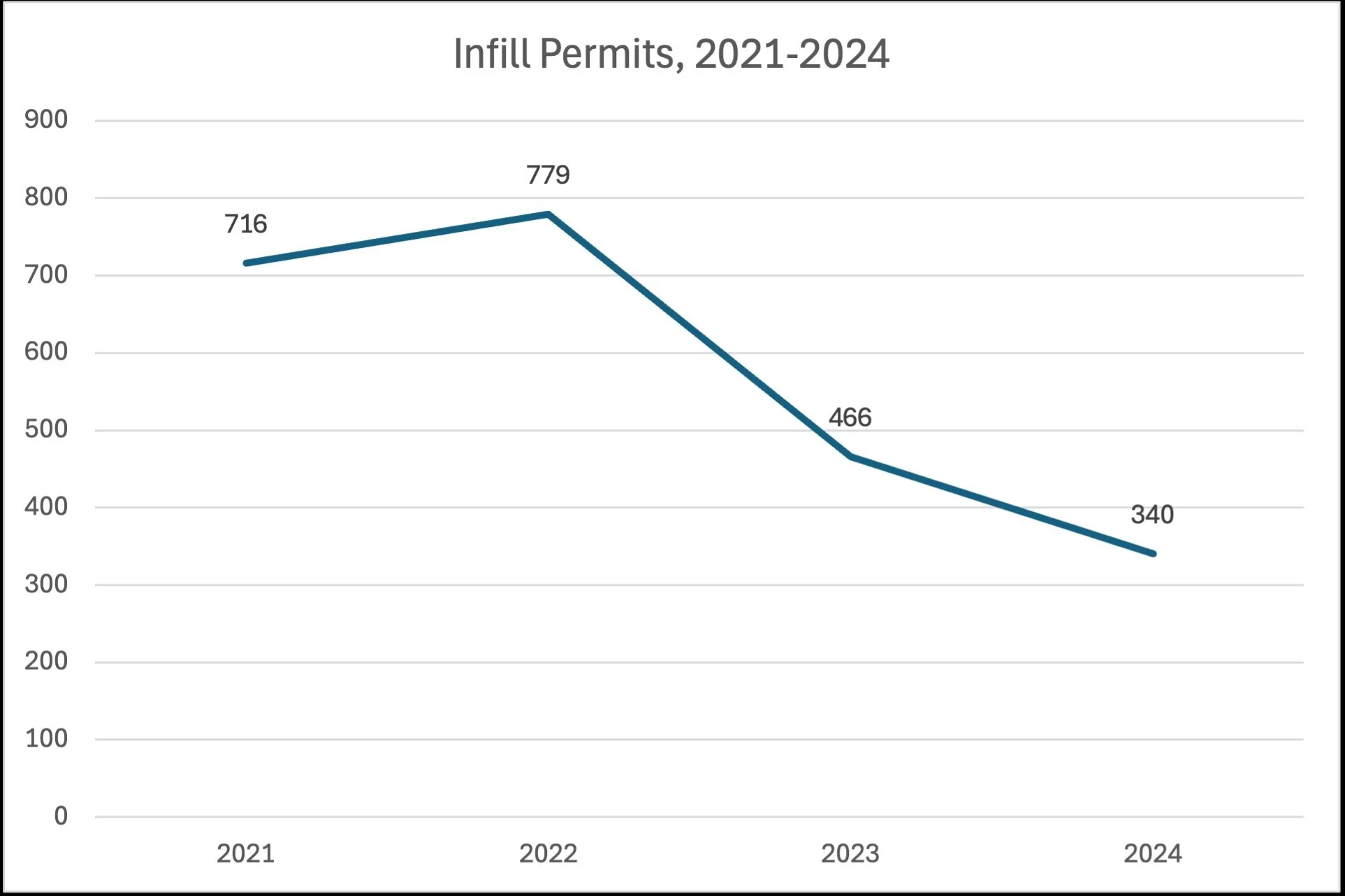
According to the data in the report, infill permits peaked in 2022 at 779 and have been on a steep decline since then, down by more than half to 340 in 2024. The report relies on this fact to claim that HOME has not led to an increase in demolitions.
True, but what the report should have looked at is the ratio of demolitions to permits—how many demolitions are we seeing, in relation to the number of permits—not simply the number of demolitions.
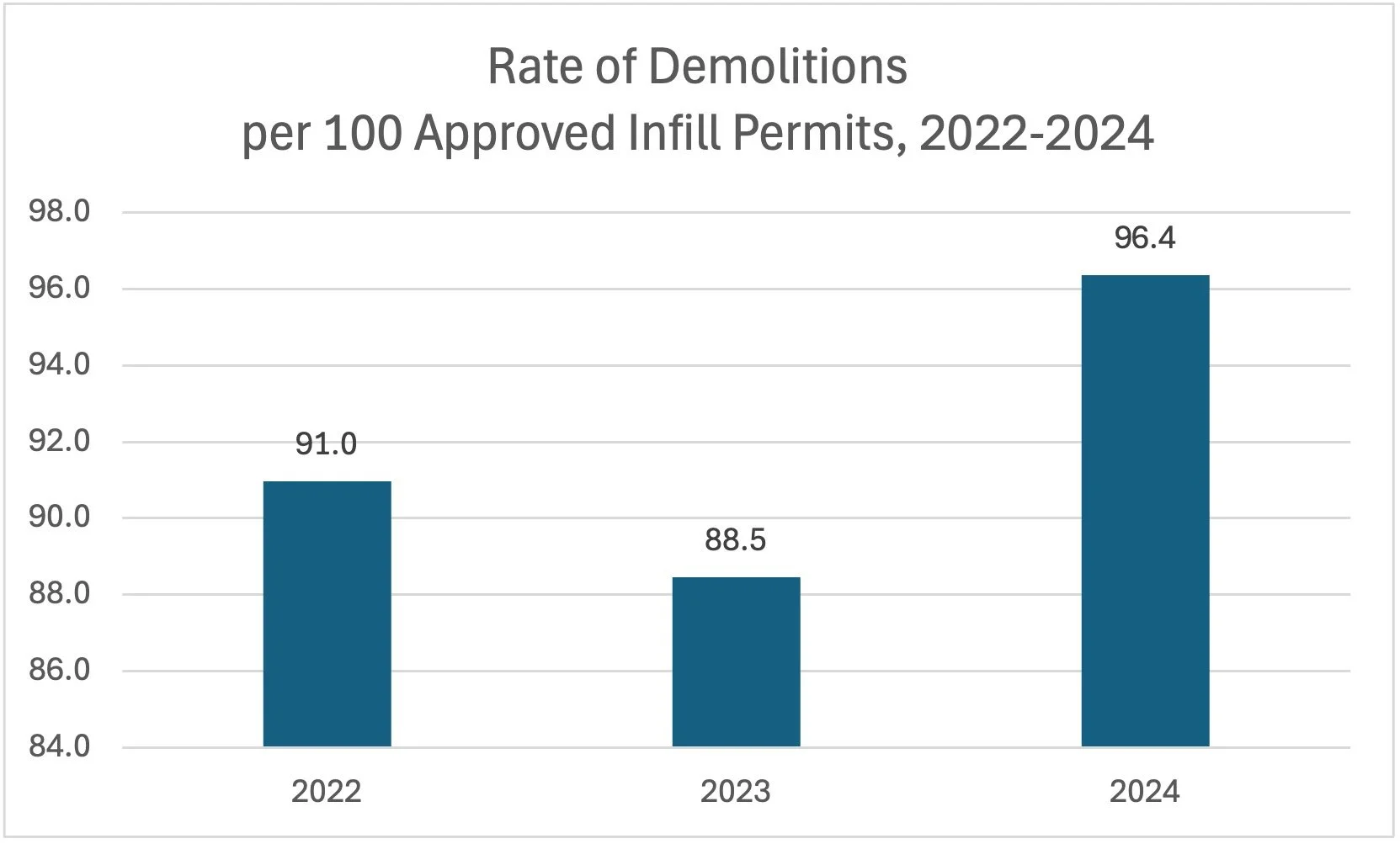
In fact, the data in the report suggests that the rate of demolitions to infill permits seems to have been declining before HOME, down to 88.5 demolitions per 100 infill permits in 2023, but has since jumped to 96.4 demolitions per 100 infill permits. In other words, while total infill permits have decreased, more of them include demolitions.
Demolitions have become a more frequent feature of the infill development that is taking place. The report hides this fact.
Did HOME cause more development in neighborhoods vulnerable to displacement?
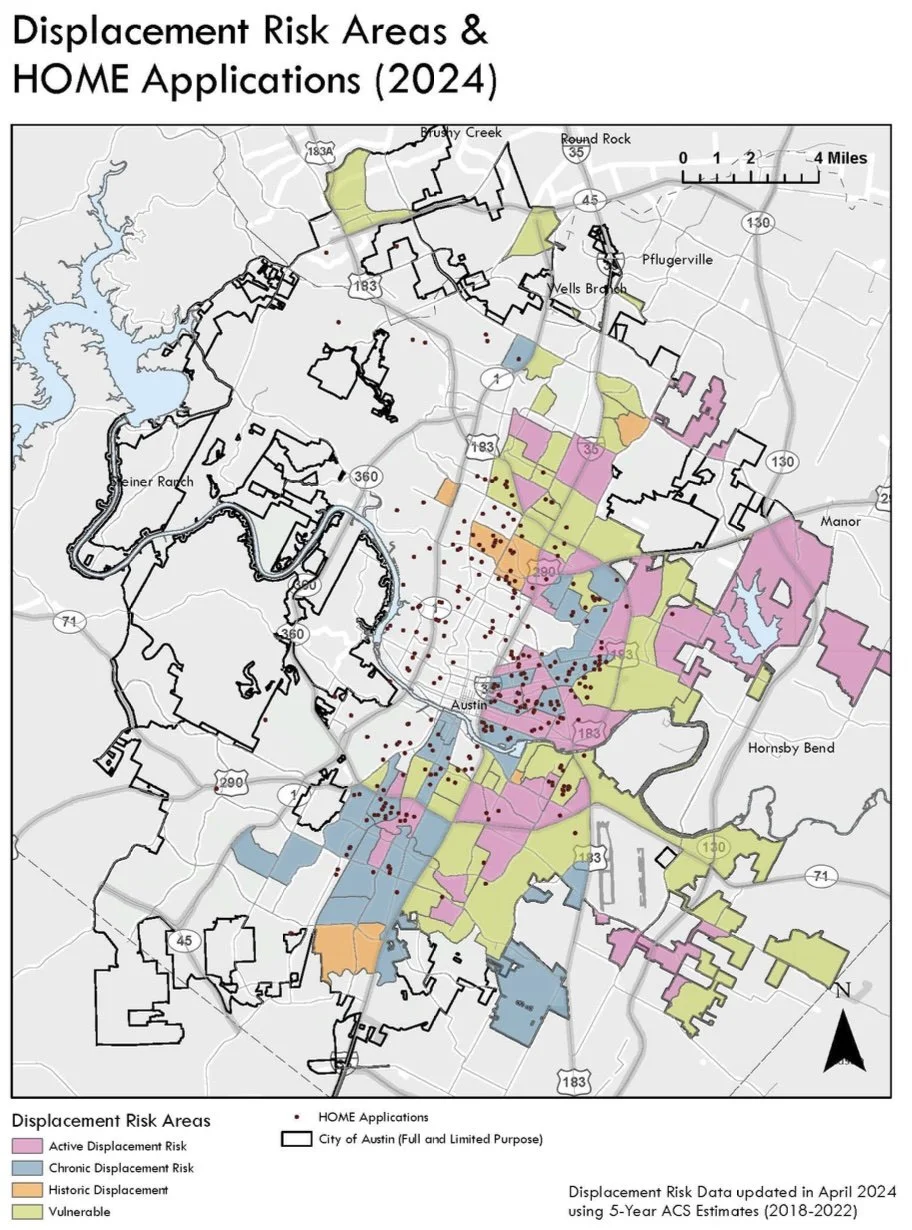
The report admits that “HOME applications are concentrated in Displacement Risk Areas,” but it asserts that “this concentration is not significantly greater than that observed in similar zoning districts prior to the adoption of HOME” (page 2).
From the data presented in the report, it is not at all clear what the authors mean here. In fact, by any reasonable standard, infill applications have increased significantly in displacement risk areas.
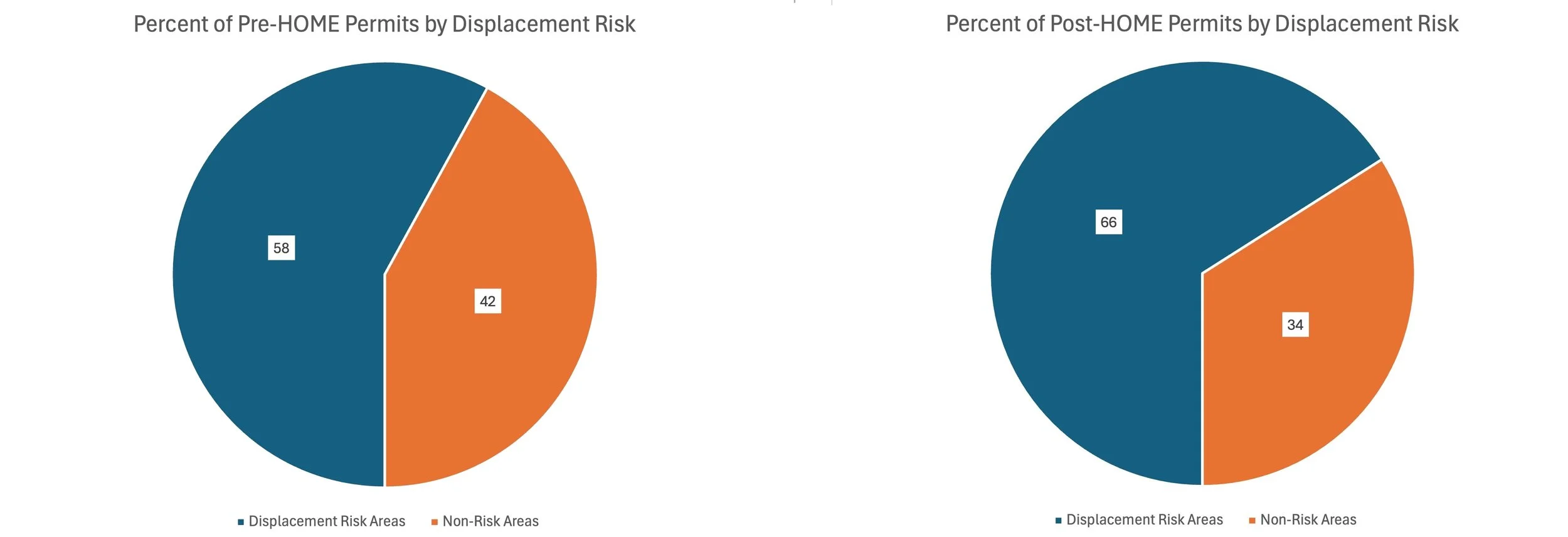
The data in the report shows that the percentage of permits in Displacement Risk Areas has increased significantly since HOME, from 58% to 66%.
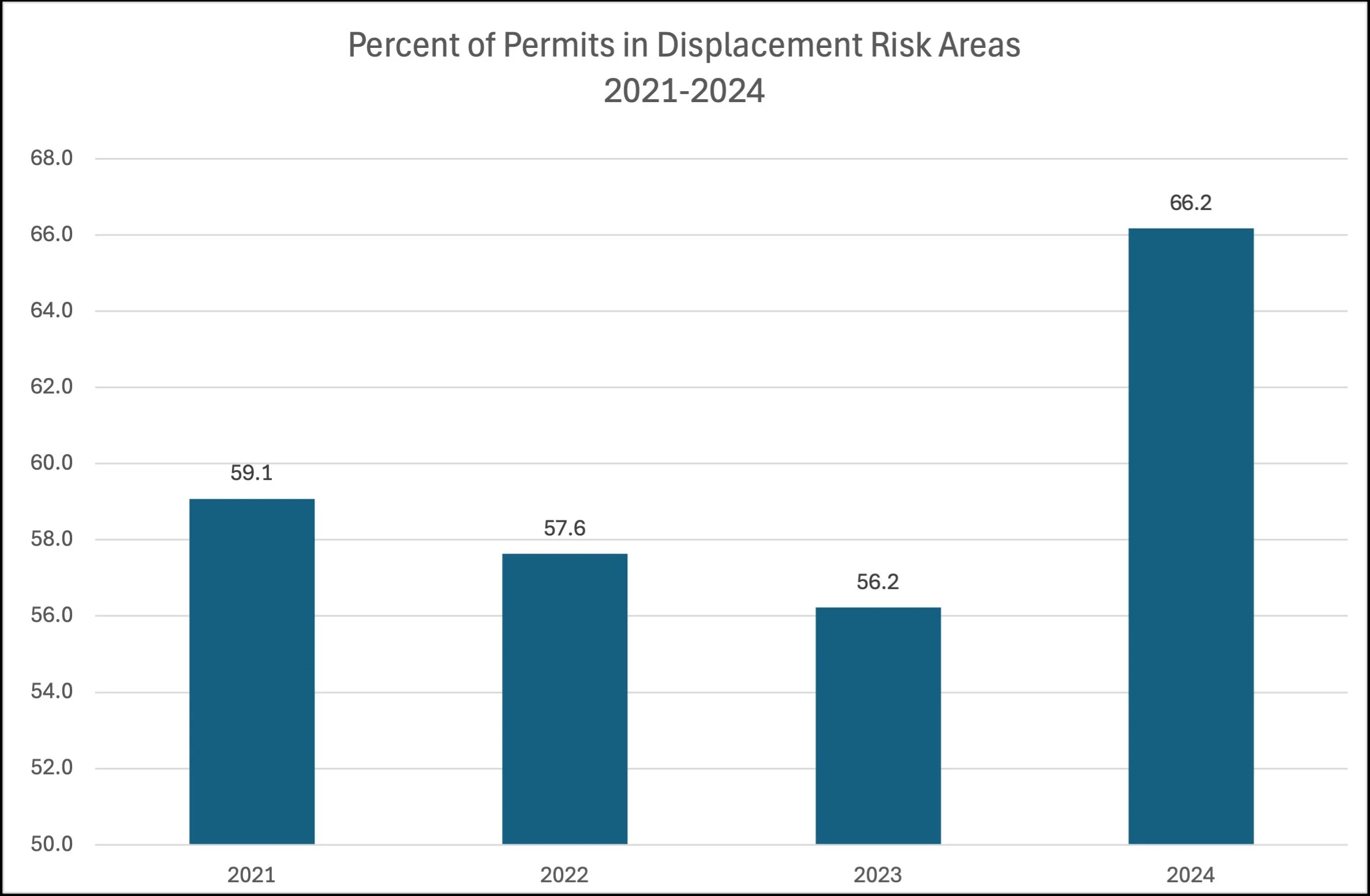
The increase is even more apparent if we look at the pre-HOME trend vs. the post-HOME spike: before HOME, from 2021 to 2023, the percent of infill permits in displacement risk areas was declining, to just 56%, but after HOME, it dramatically jumps to 66%.
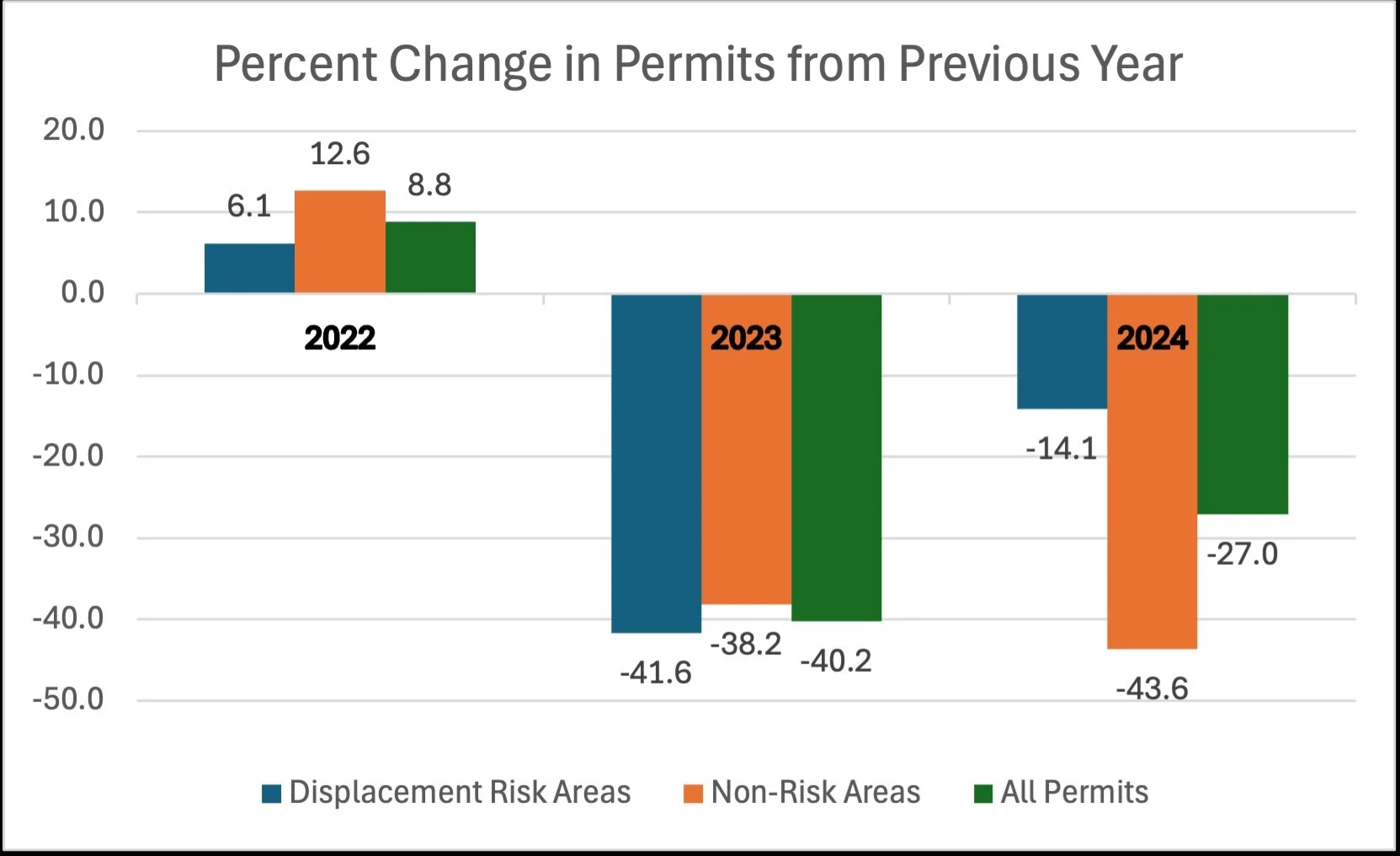
Using data from the report, we can see that when the number of permits dropped in 2023, they dropped at very similar rates between displacement risk areas and non-risk areas, but after HOME, while all infill permits dropped 27% from the previous year, they dropped 43.6% in non-Risk Areas but only 14.1% in Displacement Risk Areas. The disparity between Risk and non-Risk areas is markedly different after
HOME: during a city-wide slowdown in redevelopment activity, permits in Risk areas nearly stopped dropping. Infill permits are much more likely to be in Displacement Risk Areas post-HOME.
It is simply disingenuous spin to claim that this change is “not significant.”
Did HOME result in the preservation of naturally occurring affordable housing?
This is perhaps where the political spin is most deceptive. In the “key findings” section, repeated by some local elected officials, the report proudly announces that “projects utilizing the Preservation Bonus retained an average of 94% of the original structure, supporting the initiative’s goal of preserving existing housing stock.” This sounds very impressive: 94%! Wow!
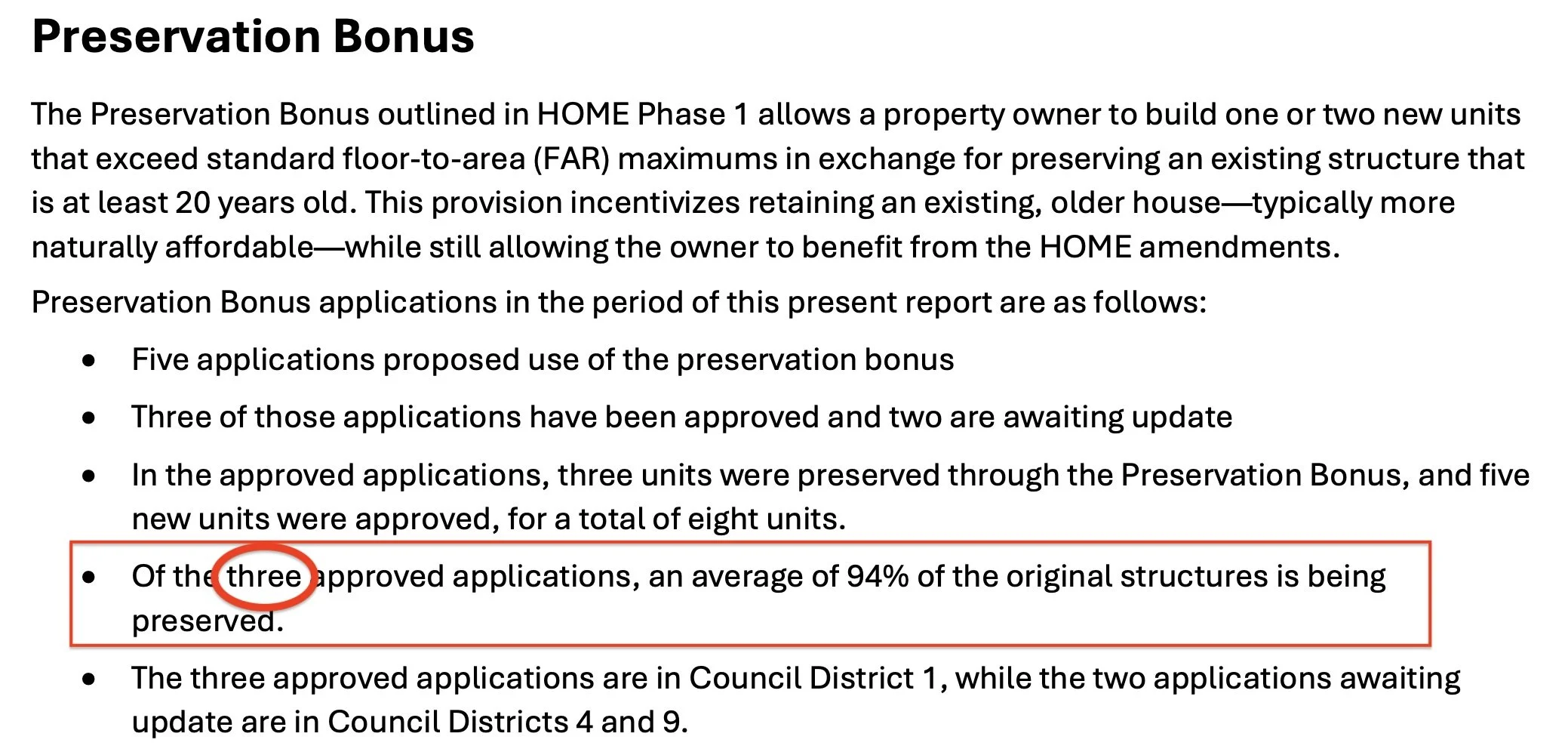
However, later in the report (page 7), we learn that only 3 out of the approved 236 permits opted into the preservation bonus program. Just over 1% of the cases.
And they seriously want us to believe that 3 buildings preserved is evidence that HOME is working to preserve naturally occurring affordable housing?
This is the kind of deceitful spin from politicians that people can’t stand.
If HOME was supposed to increase supply, why did permits go down after it passed?
HOME was sold to us as a necessary reform to land-use rules because zoning was supposedly a major barrier to the production of housing, preventing the market from increasing supply. We were told that if we loosen zoning rules, production and supply would increase and prices would become affordable.
Instead, what we’ve seen is that production—in form of new permits—has plummeted while rents have moderated by about 10% (what economists might call a “market correction”). How did that happen?
The HOME report actually tells us why:

Page 22
In other words, the report admits that zoning is a relatively insignificant factor in housing production, in comparison to “broader market conditions.” This admission undermines the main arguments that proponents of HOME used in the run-up to its passage.
Conclusion
Contrary to what city officials want us to believe, the data in the report actually shows that:
HOME has made demolitions more common in infill projects.
HOME has shifted development more towards neighborhoods vulnerable to displacement.
HOME has not incentivized the preservation of affordable housing.
Zoning is not a major barrier to housing construction, undermining the primary justification used by proponents of HOME.
We need more honesty from our local government so that we get policies and programs that actually achieve what we want—and that don’t come at the expense of the most vulnerable in our community. That’s why I’m running for City Council. Better policy. More honesty.
At the time City Council was considering HOME, many housing and social justice advocates argued that the plan lacked anti-displacement protections for at-risk neighborhoods, protections that other cities have implemented.
A study from the outside consulting firm APD-U concludes,
“The HOME Ordinance…has the potential to either narrow or widen existing inequities depending on how it is implemented. While the ordinance broadens development potential, early evidence shows that activity has been concentrated in neighborhoods already burdened by displacement, particularly throughout the Eastern Crescent. To maximize the ordinance’s equitable potential and prevent it from exacerbating existing disparities, Austin must pair HOME with an intentional, data-driven Equity Overlay that embeds anti-displacement strategies, community reinvestment, and accessibility measures into every stage of housing policy”
(page 35).
Rather than implementing such protections, the Council plowed ahead with a plan that once again ignored the most vulnerable in our community—and now they are trying to tell us that HOME is not widening existing inequities, despite evidence to the contrary.
We can do better, but it starts with being honest.
Email me with comments or questions: rich@richforaustin.org