
A New Economic Development Agenda, or the Same Old Song?
Back in 2023, using data from the US Bureau of Labor Statistics (BLS), I wrote an opinion piece for the Austin American-Statesman pointing out how the economic development model we had been pursuing from 2003 to 2020 had contributed to a growing gap between the rich and poor and the continued shrinking of the middle-class in Austin. Among other things, this dynamic has been a major driver of the housing affordability and homelessness crises in our city.
Headline of my opinion piece in the American-Statesman, April 9, 2023.
I decided to revisit BLS statistics and update my analysis with post-pandemic data because the City Council is currently considering adopting a new economic development “framework” that doubles-down on the approach that has created an Austin that is more unequal today than at any time in the last 100 years. We desperately need a new approach to economic development, not more of the same.
The Data
The BLS regularly publishes the Occupational Employment and Wage Statistics for metro regions across the country, which shows the number of jobs in different occupations and the median wage for those occupations. For example, it shows that in May 2024 (the most recent data available), 1,260,220 people were employed in the Austin metro area. The median wage for all jobs was $52,610. 120,850 people were employed in the lowest-paying occupation category, Food Preparation and Serving, which paid just $31,200 per year or $15 an hour. Nearly the same number of people, 128,150, worked in Management, which paid $126,190 annually or $61 an hour—more than 4 times food service workers.

A selection of May 2024 Occupational Employment and Wage Statistics for Austin metro.
Food service workers make only 59% of the median wage, while managers make 240% of the median wage. Overall, we can break jobs into three categories, Low-income (making less than 80% of the median wage), High-income (making more than 200% of the median), and Middle-income (those between 80% and 200% of the median). Furthermore, because these statistics are published regularly, we can compare the distribution of jobs and wages today with those going back to 2001 (the oldest comparable data set available).
In 2001, 658,400 people had jobs in Austin, with an overall median wage of $28,080. Managers made $60,760, or 214% of the median, with food service workers making $14,850 a year or 53% of the median.

A selection of 2001 Occupational Employment and Wage Statistics for Austin metro.
Dividing jobs into low-, middle-, and high-income shows that in 2001, 29% of jobs were in low-income occupations, 59% were in middle-income, and just 12% would have been considered high-income jobs:
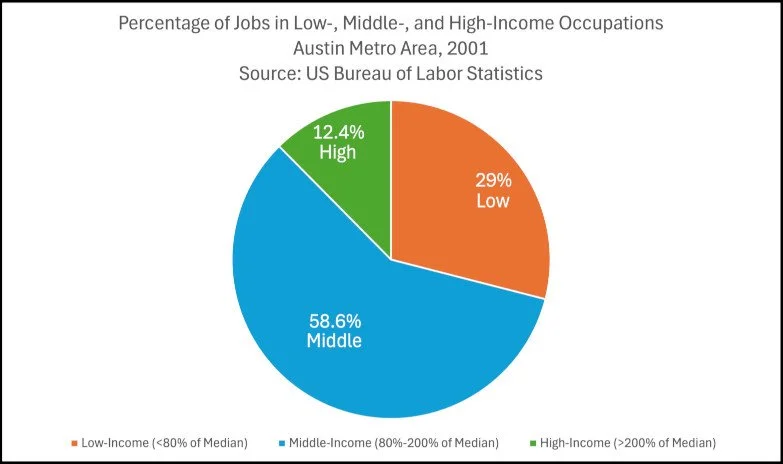
Percentage of jobs in low-, middle-, and high-income occupations in Austin in 2001.
By 2024, however, middle-income jobs had shrunk to 50.9% of all jobs, with high-income jobs increasing to 16.5%, and low-income jobs jumping up to 32.6%. A full 1/3rd of workers in Austin are now employed in low-income jobs, while just barely above half of all workers have middle-income jobs:
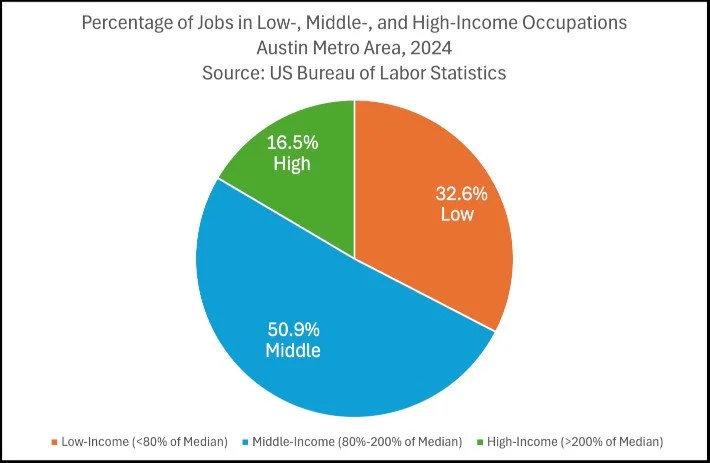
Percentage of jobs in low-, middle-, and high-income occupations in Austin in 2024.
Comparing 2001 to 2024 (below), we can see that while the percentages of jobs in high- and low-income occupations in Austin grew, middle-income jobs shrank as a percentage of all jobs. The structure of Austin’s economy has changed, from one with a good-sized middle-class to one with a large low-paid class, a growing, but smaller upper-class, and a shrinking middle-class. Our city has become more economically polarized over the last generation, which should be alarming to everyone, especially since back in 2015 Austin was identified as the most economically segregated city in the US. Things have only gotten worse since then.
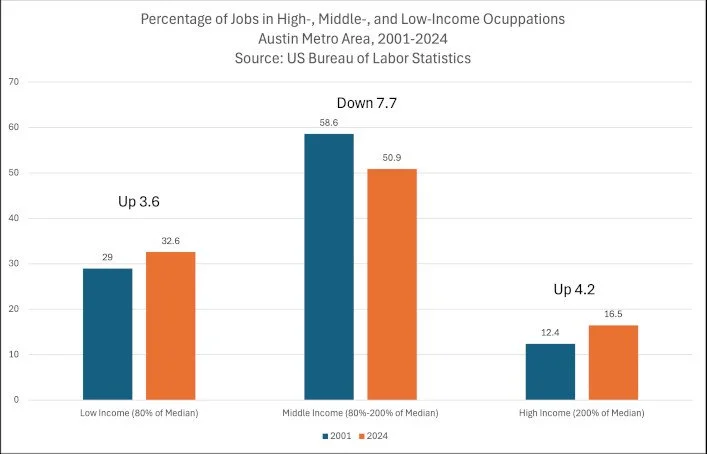
Job growth in all, low-, middle-, and high-income occupations, 2001-2024.
Between 2001 and 2024, 601,820 jobs were added to the Austin economy (see below). Only 42% of new jobs were in middle-income occupations. A full 37% of new jobs were in low-paying occupations, while high-paying jobs were just 21% of all new jobs in the area. Austin gained nearly as many low-income jobs as middle-income ones.
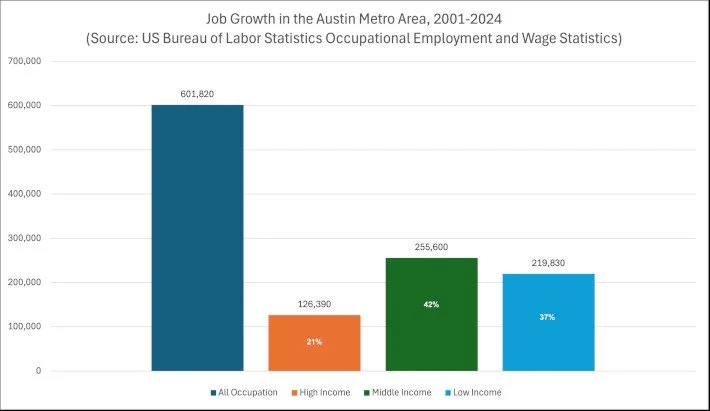
Job growth in all, low-, middle-, and high-income occupations, 2001-2024.
We can start to understand this structural change in Austin’s economy by looking at the two fastest-growing occupations, management and food service, the two job categories with the highest and lowest median annual wages. Management jobs, which in 2024 paid $126,000 a year, grew by almost 78,000; food service jobs, paying just $31,000 a year, grew by 74,000:
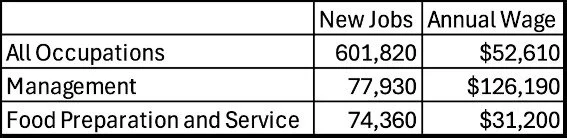
Fastest-growing occupations, 2001-2024, with median annual wage.
People in well-paying jobs tend to dine out more often than middle- or low-income folks, so when the proportion of high-paying jobs, such as managers, grows, so does the percent of low-paying food service jobs. Likewise, high-income earners buy more goods, pushing up demand for more retail sales jobs, which was among the fastest-growing job categories at 40,500 new jobs, paying just $39,000 per year. Because there are proportionally more high-income earners today, demand for historically low-paying occupations increases, even while middle-income jobs decline.
Economic Development, Then—2003
The economic development playbook that has created a more unequal Austin than ever before, that caused a massive displacement of people of color, and that left us in a budget crisis, was established in 2003. The blueprint for this economic development model is a report that was presented to the City Council on April 9, 2003, entitled Austin’s Economic Future: The Mayor’s Taskforce on the Economy. It calls for the aggressive recruiting of businesses to bring in “higher quality” jobs and to enhance the tax base through new construction. It proposes achieving these goals through “public-private partnerships” (which means tax break incentives), streamlining of development and permitting processes (deregulation), and aggressive marketing, all of which are paid for by our tax dollars.
From the title page of the 2003 report, Austin’s Economic Future: The Mayor’s Taskforce on the Economy.
This economic development model subsidized businesses through tax breaks (corporate welfare: see my previous blog, Why are Austin taxpayers subsidizing record revenue for Southwest Airlines?) in order to bring in high-paying jobs and to theoretically create a larger tax base. The priorities of the city have been catering to these businesses and their well-paid employees at the expense of the middle- and working-classes, who have seen the effective tax base eroded by the expansion of services (utilities, infrastructure, public safety) associated with development. Development has not paid for itself; instead, we have had to pay for it.
Development that caters so narrowly to high-income earners has left the rest of us behind, as housing prices have skyrocketed in response to the influx of new wealth, which is not “trickling” down to working people. Instead, we’ve seen the decline of the middle-class and the expansion of low-paying jobs, often with few benefits, no job security, poor working conditions, little opportunity for advancement, and no dignity.
Those people toiling in low-paying jobs today are also struggling with a lack of affordable housing, as the housing market overwhelmingly caters to the well-paid, investors, and luxury second homes (see my previous blog, Austin’s Housing Shortage Reality). Many are one health crisis away from the street—or already there.
Economic Development, Now—2026
On May 7, the City Council is considering adopting a new “economic development framework” that is remarkably similar to the 2003 playbook, essentially doubling down on the same strategies that have led us to the current situation: targeting “high value” developments and jobs to “generate high sales tax” and “high property tax density” by taking “an aggressive stance towards economic development” and “reestablishing” the City Council “as a full, active, and strategically intentional economic development actor.”
Cover of the presentation to City Council’s Economic Opportunity Committee.
The “new” economic development “roadmap” is painfully blind to the impacts of the last 20+ years of growth, which has aided the gutting of the middle-class and expansion of low-paying jobs that service a small wealthy class. The resolution before Council asserts that an economy that produces more inequality and economic polarization is “the envy of the nation” and is “not in tension with Austin’s values”:
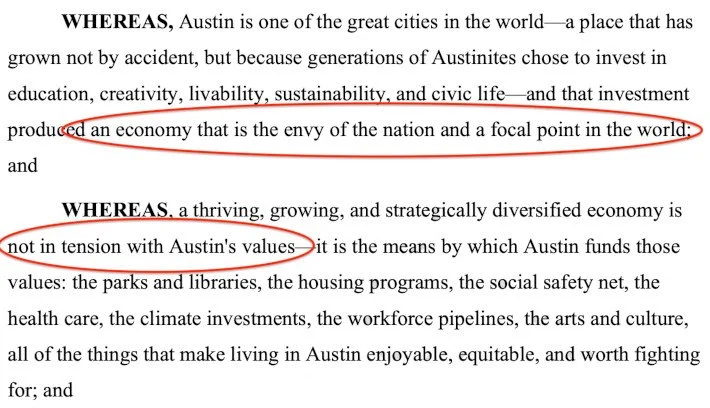
The first “whereas” clauses of the economic development resolution before Council.
If our economic development has been so darn successful, why are we currently in a budget crisis, with increasing disparities, a housing crisis, and a rise in homelessness?
Economic Alternatives
Instead of super-charging the same failed economic development script, we need to adopt new economic development priorities that focus on improving historically low-paying jobs, growing the middle class, and creating an economic foundation that is less dependent on the whims of Wall Street and the profit incentives of global capital. Rather than directing more resources to recruiting “high value” development, we should be investing heavily in growing local & employee-owned businesses and other enterprises that help keep money local, instead of sending profits back to investors on Wall Street or overseas. Local and employee-owned businesses are more resilient, less likely to lay off people, less likely to pollute the local environment, and less likely to make decisions that do not benefit the wider community—because they live in and are part of that community. Instead of “aligning” our “workforce development” (i.e. education) to the needs of big tech and “advanced manufacturing” (i.e. Tesla), we should be fostering a community mindset that is geared towards meeting people’s human needs, not the needs of distant, profit-seeking investors.
Otherwise, we are doomed to another generation of increased inequality, displacement and homelessness, leading to more budget crises and cuts to basic services. For 20+ years we’ve been building a city for the wealthy. It’s time we prioritized the other 83.5% of us.
Email me with comments or questions: rich@richforaustin.org