
Austin’s Housing Shortage Reality: Follow The Money
In the last few years, we’ve been told over and over again that housing has become so expensive because of a housing shortage in Austin—and in the country in general—and that to bring down rents and home prices, drastic reforms are needed to zoning and other local regulations to increase the supply of housing. According to this line of thinking, the crisis of housing affordability is really a crisis of supply caused by government regulations that get in the way of the market functioning as it should.
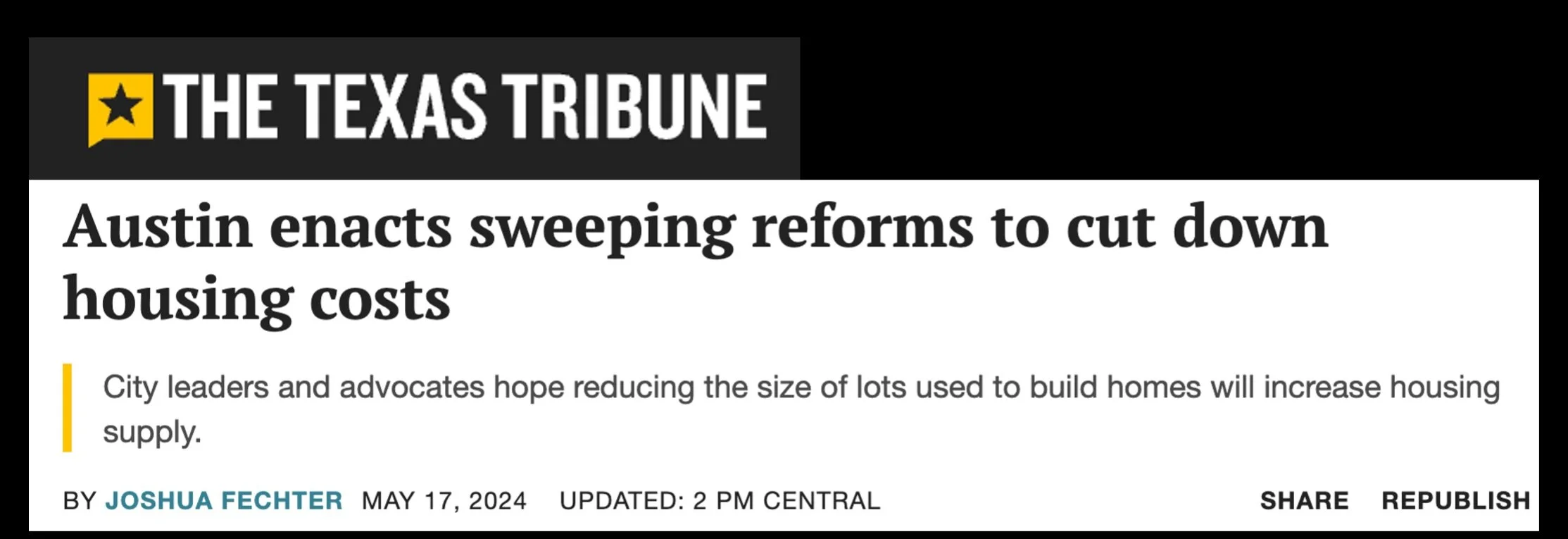
Example of a local news story linking zoning reforms to housing supply and cost.
The argument goes like this:
Prices are high because there aren’t enough homes for everyone.
There aren’t enough homes because pesky government regulations, such as zoning, have stifled the production of housing.
We have to sweep away local regulations in order to build enough housing for people.
It’s a crisis, so it’s urgent that we do whatever we can, as soon as possible, to allow more housing.
It’s a generational battle between older homeowners (“NIMBYs”), and younger renters (“YIMBYs”).[1]
[1] NIMBY stands for Not In My Back Yard, a term that is supposed to imply homeowners who are self-interested and are blocking reforms that will bring down housing costs. YMIBY is a term coined in the 2010s that is supposed to indicate people who want more housing: Yes In My Back Yard.
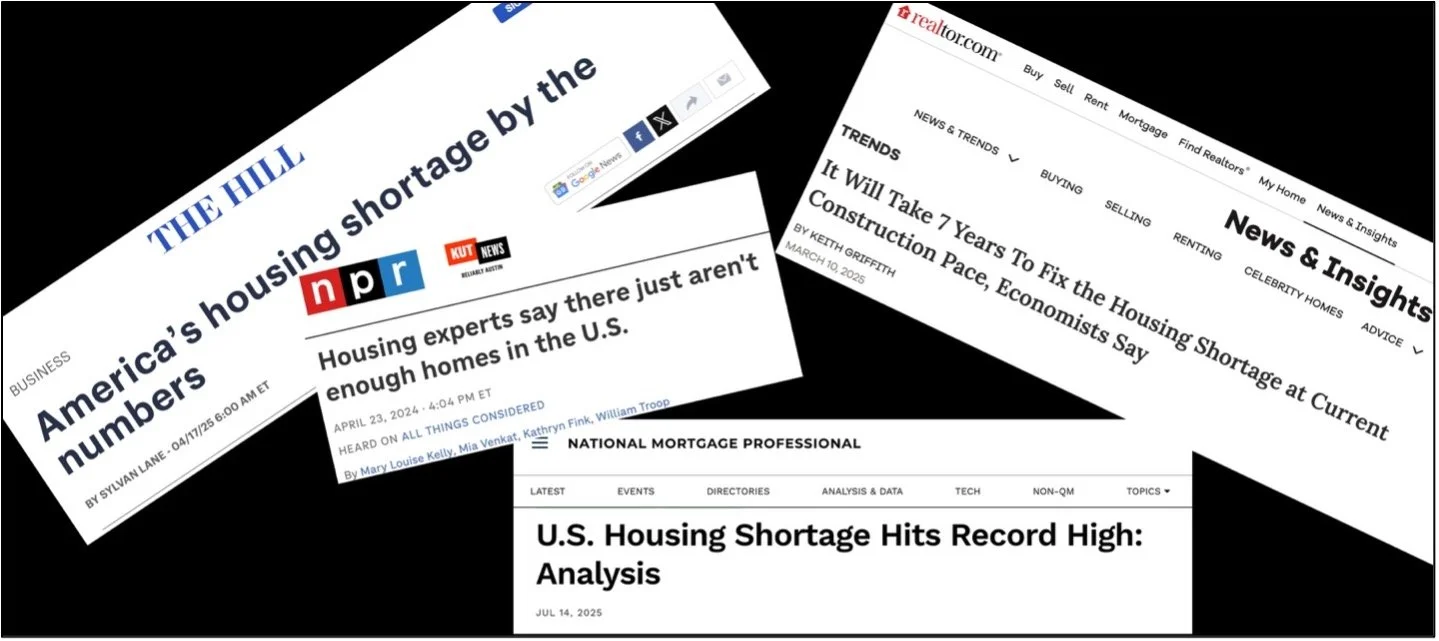
Examples of stories proclaiming a national housing shortage.
The reality is quite different. Blaming high housing costs on local land-use regulations, such as zoning, is a form of distraction that takes us away from the kinds of things that are actually driving up housing costs, such as a lack of subsidized housing for lower-income Austinites, the flow of investment capital into housing, and the related holding of housing units off the housing market. So why are we being told that the real problem is the “housing supply crisis?” Just follow the money.
This post is about why we should be very skeptical about current claims that the root of the housing affordability crisis is a shortage of housing units and that zoning and “NIMBYs” are primary barriers to affordable housing for everyone. As I’ll talk about below, we should question this story not only because it oversimplifies the housing market, but also because of who is telling us the story. The “housing supply crisis” has been manufactured and sold to us by development and real estate interests. They see our basic human need for shelter as a realm ripe for further exploitation and wealth extraction; they see zoning as a barrier to higher profits. And they are trying to pit us against one another by making moderate-income homeowners seem like the bad guys, intent on blocking meaningful reform. This argument divides us and distracts us from what we really need to do to bring housing costs down.[1]
[1] In a future blog post, I will talk about how real estate and development interests have been packaged and sold to us by extreme right-wing, libertarian thinktanks and organizations linked to the fossil-fuel-billionaire Koch brothers, and libertarian tech billionaires that have recently moved to the Austin area.
Is there is a housing shortage in the US?

It is common in discussions of the housing crisis to hear that the production of housing has not kept up with population growth. For example, in their wildly popular book, Abundance, Ezra Klein and Derek Thompson claim that “in the late 1970s, home construction started to fall behind the pace of population growth” (page 25). Their major evidence for this claim is a comparison of the average number of housing units per 1,000 people between OECD countries (the 38 most industrialized countries) and the US, showing that the US has a much lower rate than Germany, France, Japan, etc.
While this is true, it is misleading because Klein and Thompson fail to mention the fact that the number of housing units per 1,000 people in the US has been increasing since at least 1950 and was at an all-time high in 2024, at 431 units per 1,000:
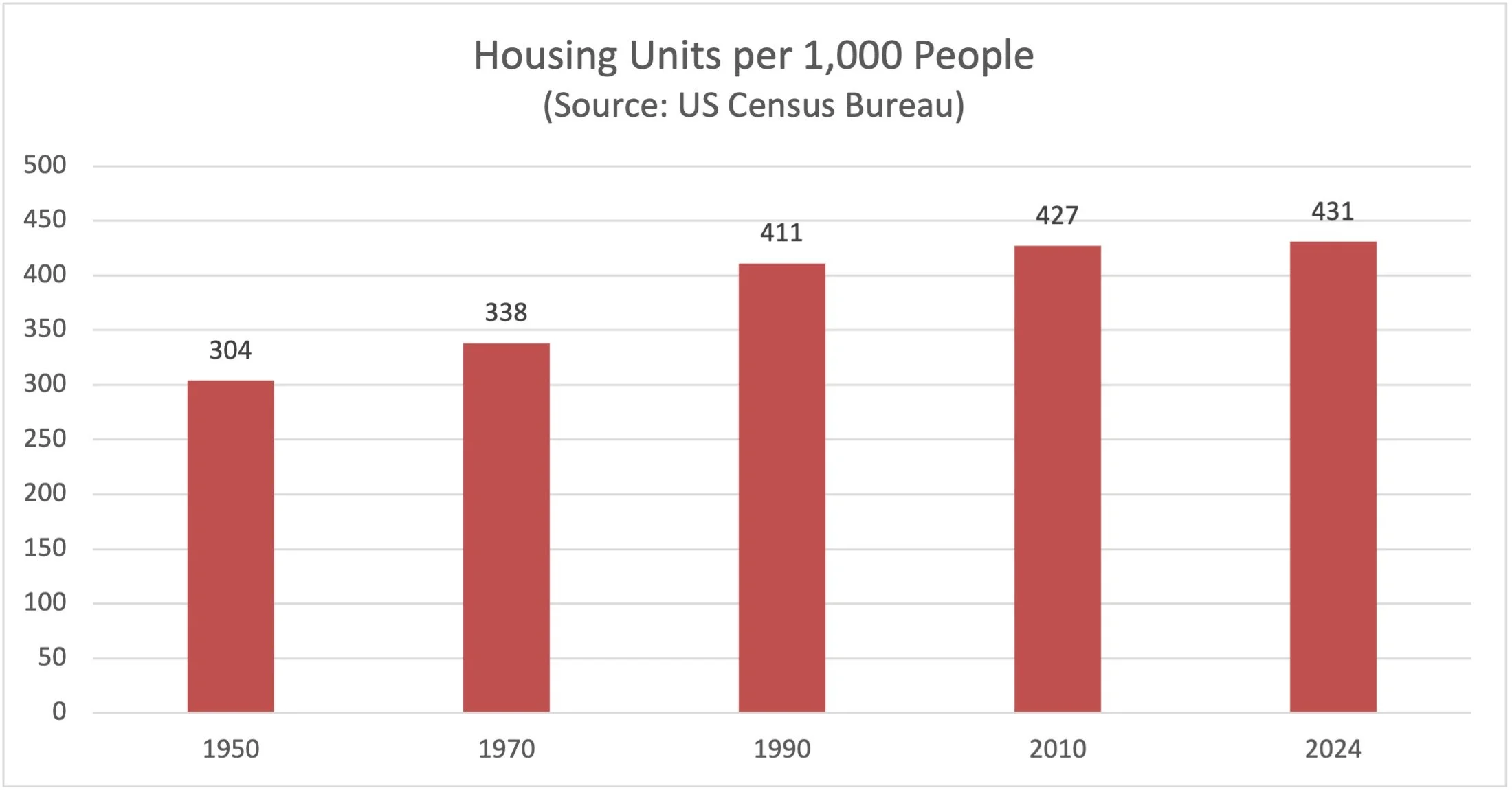
Housing units per 1,000 people in the U.S., 1950-2024. Graph by the author. Data from US Decennial Censuses.
True, the rate of increase appears to be slowing (but note that the increase of only 4 points between 2010 and 2024 is partly attributable to the fact that the interval is only 14 years, rather than 20), but the upward trend over time undermines a basic argument that supply has been stifled since the 1970s. Supply, as measured by units per 1,000 people, has been increasing for 75 years.
Another way to look at the issue is to chart the different rates of growth of housing and population over the course of the modern era:
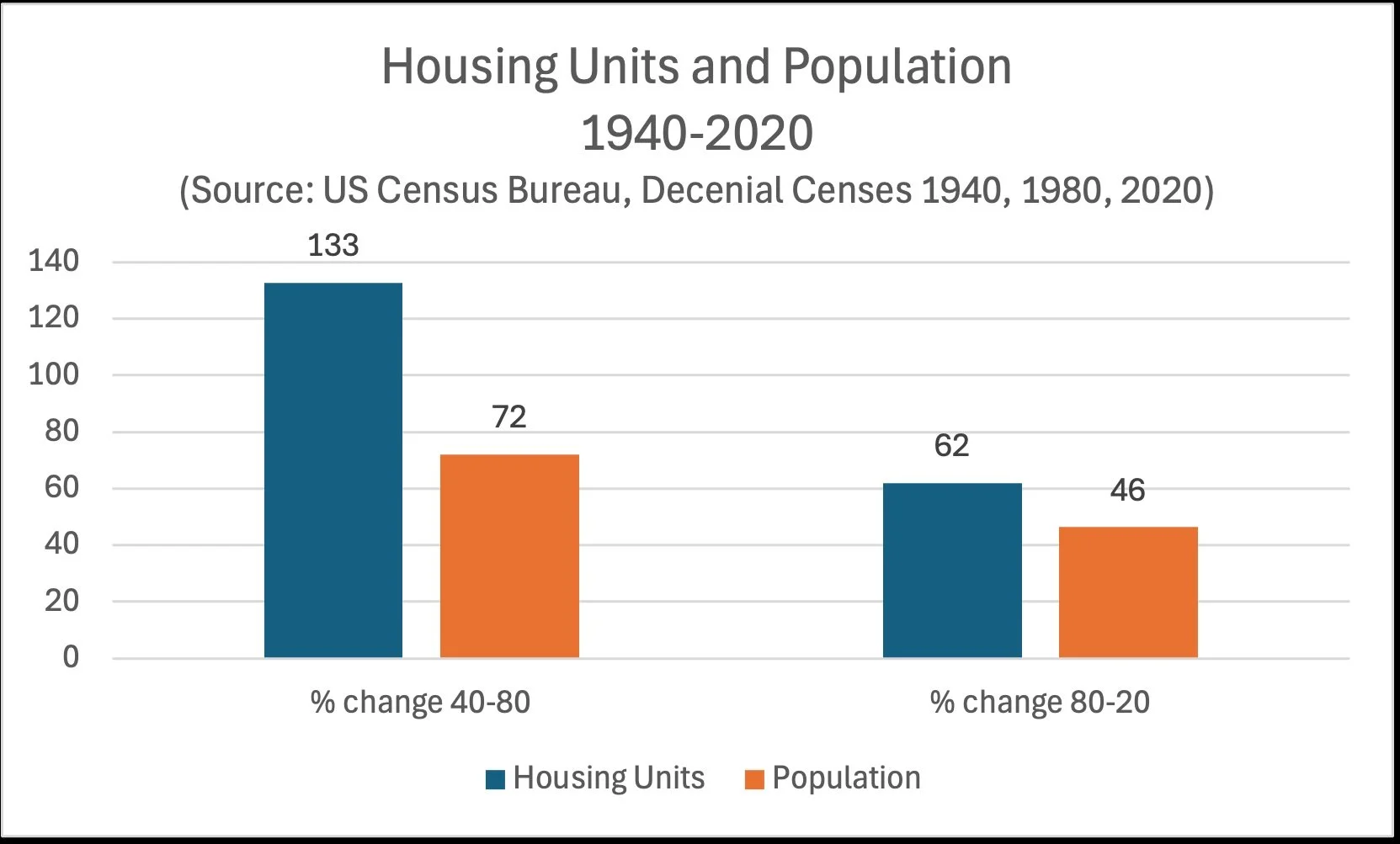
Percentage Change in U.S. housing units and population growth, 1940-2020. Graph by the author.
Between 1940 and 1980—the golden era of homebuilding—the number of housing units in the US increased by 133% (more than doubled), while the population grew by 72%. 1.35 new housing units were built for each person added to the population. Between 1980 and 2020—the period in which many advocates for housing deregulation claim housing fell behind population growth—there was an increase in housing units of 62%, while population grew just 46%. Housing construction still outpaced population growth: 1.11 units were added per new person. It is true that the rate at which housing growth outpaces population growth has slowed (1.11 vs 1.35), but it is not true, as Thompson and Klein maintain, that housing production has fallen behind population growth.
In a recent peer-reviewed, in-depth analysis of nation-wide and metro-level census data, housing scholars Kirk McClure and Alex Schwartz conclude that “from 2000 to 2020, housing production exceeded the growth of households by 3.3 million units. Of the nation’s 381 metropolitan areas, only four experienced a housing shortage during this time”.[1] Austin was not one of those four.
In an email to me, McClure confirmed, “Austin does not have a shortage. From 2000 to 2020, Austin grew by 408,813 households with housing stock growth of 450,760, resulting in a surplus (expansion of the inventory of vacant homes) of 41,947.”
Even a recent report by the Center for American Progress that buys into the National “housing shortage” argument shows that there is no supply crisis in Travis County:
[1] Kirk McClure & Alex Schwartz (2025) Where Is the Housing Shortage? Housing Policy Debate, 35:1, 49-63,
DOI: 10.1080/10511482.2024.2334011.
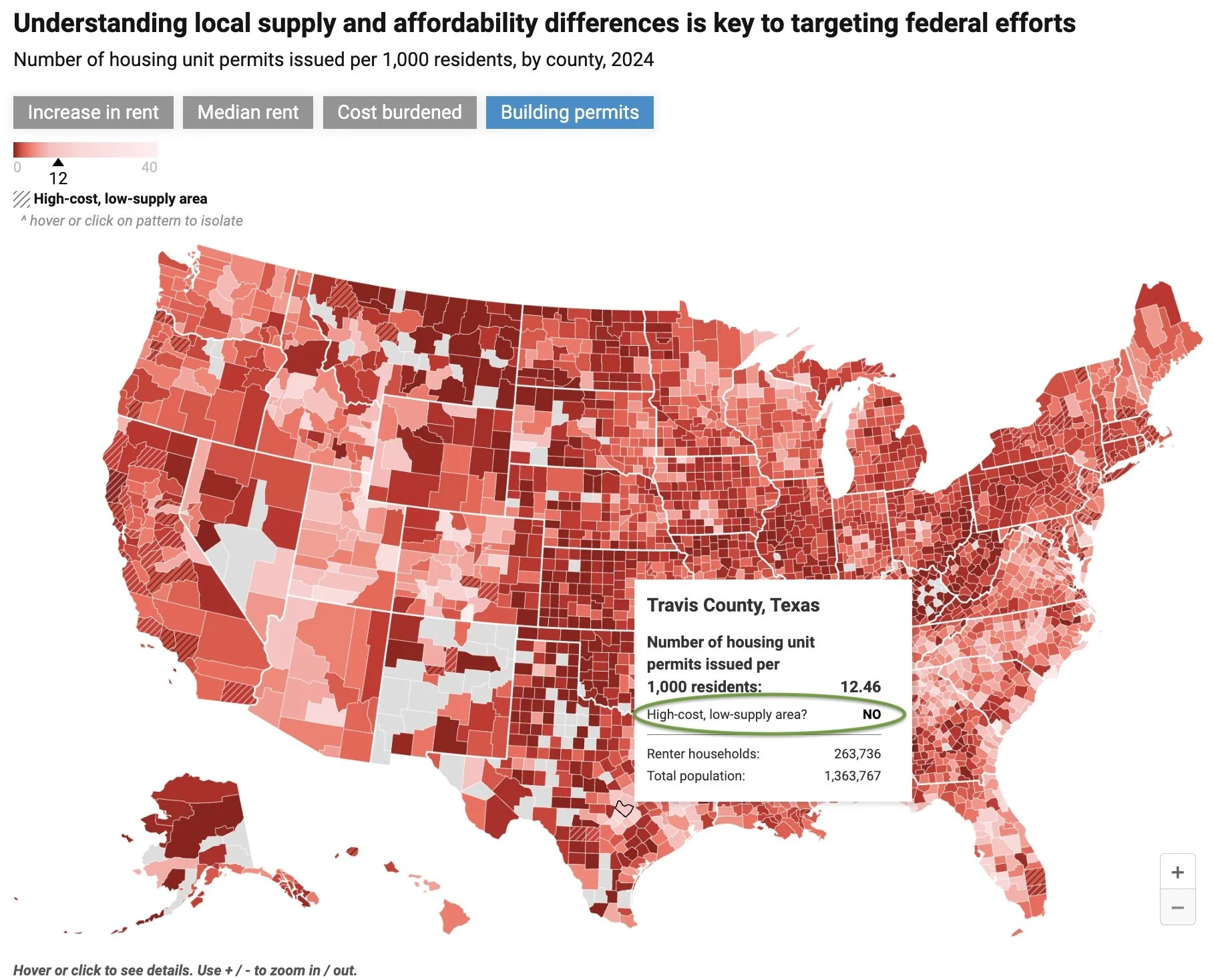
From Jared Bernstein, Michael Negron, and Natalie Baker (2025) Build, Baby, Build: A Plan to Lower Housing costs for All. November 17, 2025. Center for American Progress. https://www.americanprogress.org/article/build-baby-build-a-plan-to-lower-housing-costs-for-all/.
Yet, despite this evidence, we are constantly being told that Austin has a shortage of housing units. Why? Follow the money.
Who says there’s a housing shortage?
If there are enough units to house the current population, both nationally and in 98.95% of US metro areas (including Austin), then where do we get the idea that the affordability crisis is caused by a gap between population growth and housing units built? The short answer: from the real estate and development industry. We can see this clearly in the chart below, from a recent research report by the Brookings Institution, a free-market thinktank, that shows six of the most cited estimates of a housing shortage, all of which come from sources that have a direct financial interest in new housing construction.
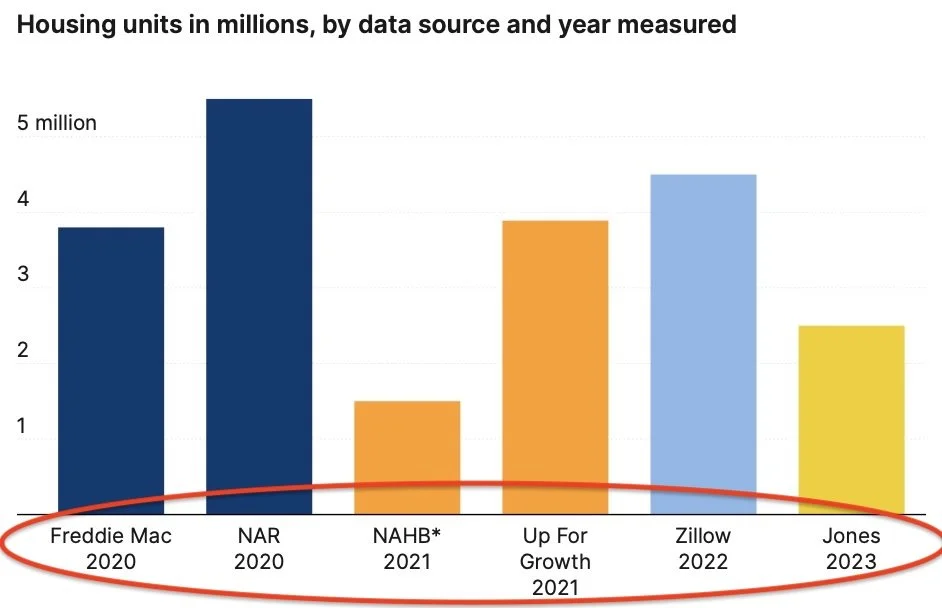
From Elena Patel, Aastha Rajan, and Natalie Tomeh (2024) Make it count: Measuring our housing supply shortage. November 26, 2024. https://www.brookings.edu/articles/make-it-count-measuring-our-housing-supply-shortage/.
The sources are: 1) Freddie Mac, the government-sponsored entity that plays a key role in the mortgage market, 2) the National Association of Realtors, 3) the National Association of Home Builders, 4) Up For Growth, a coalition of real-estate-adjacent groups premised on the idea of a housing shortage, 5) Zillow, the real estate platform, and 6) realtor.com. All of these entities benefit from policies that deregulate land-use and zoning rules.
Among these groups, Up For Growth is a relative newcomer that has used its generic, positive name to aggressively promote these ideas to the public and obscure its ties to the real estate and development industry. Up For Growth is “a national, cross-sector member network committed to solving the housing shortage and affordability crisis” (https://upforgrowth.org/who-we-are/). A page from their 2024 report on “Housing Underproduction” reveals that their members/funders include major real estate and development firms, including CBRE, the world’s largest real estate services and investment company, and Trammell Crow, a major Texas-based developer with links to conservative republicans.[1] Both are major players in Austin real estate.
[1] Harlan Crow, successor to his father’s real estate empire, was implicated in Clarence Thomas’ ethics scandals in 2023. https://www.propublica.org/article/harlan-crow-slashed-tax-bill-clarence-thomas-superyacht.
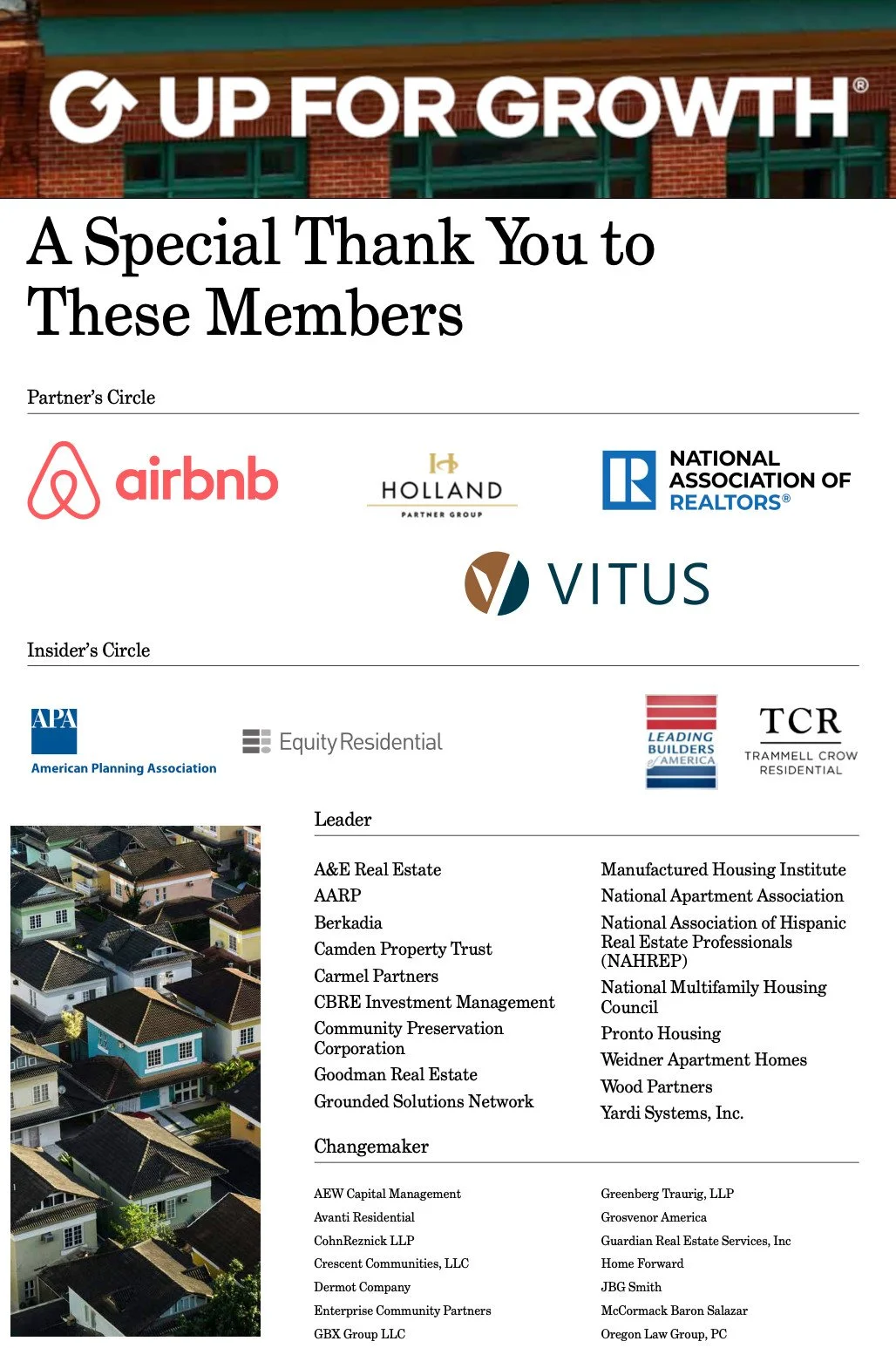
Page from Up For Growth (2024) Housing Underproduction in the U.S., showing their members/funders. https://upforgrowth.org/wp-content/uploads/2024/10/2024_Housing-Underproduction-in-the-U.S.-Report_Final-c-1.pdf.
Why are real estate industry estimates so high?
One reason many of these studies claim that there is a shortage of housing is because they assume that high prices “signal” a shortage. In other words, the economists hired by the real estate industry to create these studies begin with the assumption that there is a shortage and then try to figure out how big it is.
According to David Wessel, at Brookings, “the estimates of the housing shortage most often quoted in the press, by politicians and by White House economists, rely on vacancy rates—the number of vacant homes as a share of all housing units”.[1] They look at vacancy rates today and compare them to an “historical average” or a “normal” rate that economists postulate represents a “healthy market.”
According to this approach, economists can measure the difference between the vacancy rate of all housing units today and the “normal” or “healthy” rate and come up with the number of “missing” units, or the shortage of housing units. Depending on what each researcher determines is the “normal” or “natural” vacancy rate, and on various adjustments, the studies come up with different numbers for the size of the housing shortage.
A key point in the estimates based on vacancy rate is that they usually count all vacant units, which includes not just for-rent or for-sale units, but also seasonal units (i.e. second or vacation homes) and units held off the market (for short-term rentals, like Airbnbs, or simply investment units left empty). In other words, they count houses and housing units not intended for housing:
[1] David Wessel (2024) Where do the estimates of a “housing shortage” come from? October 21, 2020. https://www.brookings.edu/articles/where-do-the-estimates-of-a-housing-shortage-come-from/.
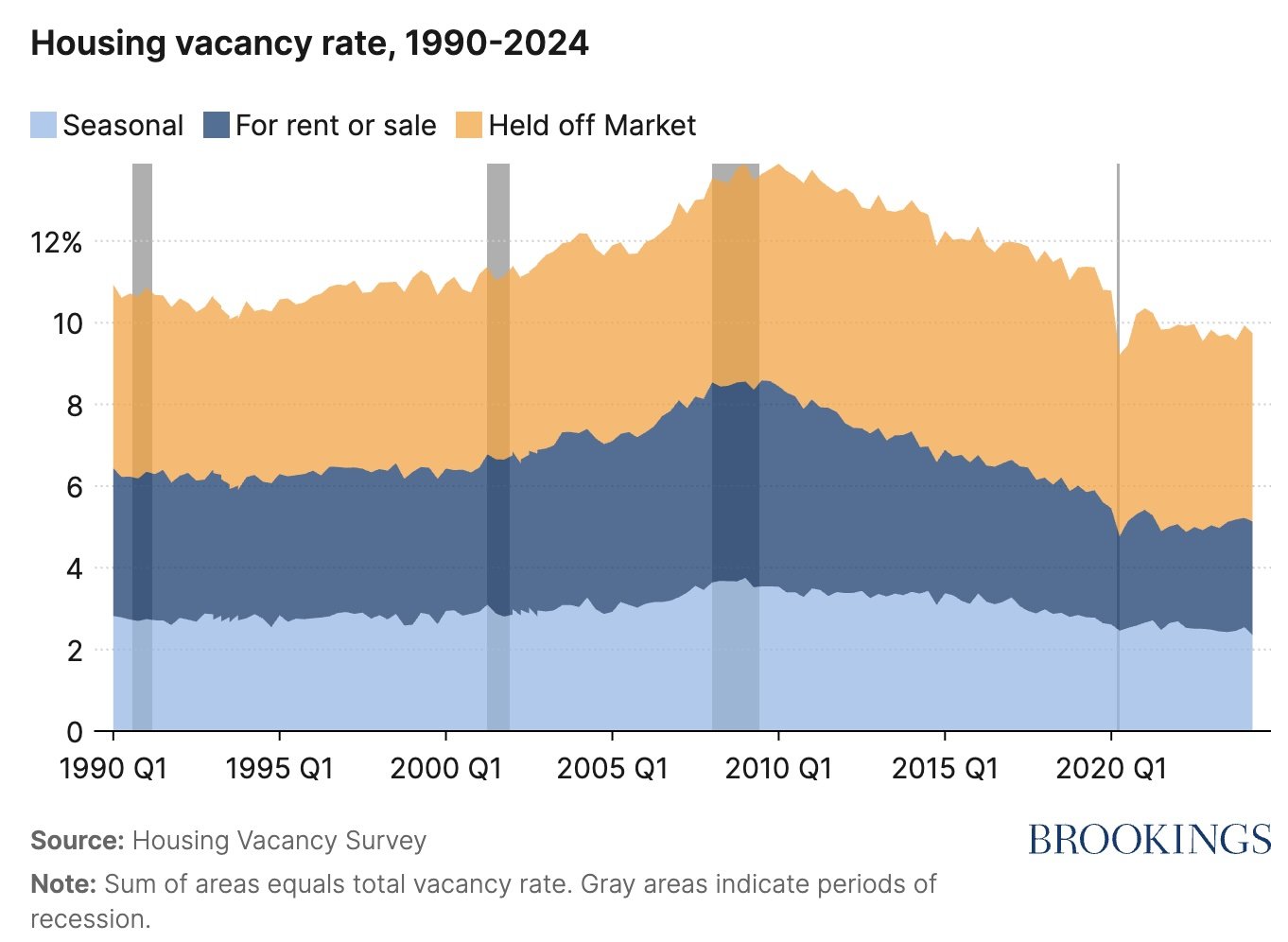
From Elena Patel, Aastha Rajan, and Natalie Tomeh (2024) Make it count: Measuring our housing supply shortage. November 26, 2024. https://www.brookings.edu/articles/make-it-count-measuring-our-housing-supply-shortage/.
In 2024, 9.8% of all US housing units were vacant, with units held off the market accounting for the largest chunk at 4.6%, vacant for-sale or for-rent units comprising 2.8% of all units in the US, and vacant seasonal units making up 2.4%. This means that units held off the market and seasonal units constituted 71% of all vacant units; housing units for sale or for rent made up just 29% of all vacant units. Most of the vacant “housing” units counted are not for people who need housing; they are for investments and second homes for the wealthy.
Using this method, the Brookings report by Patel, Rajan, and Tomeh estimates that it would take around 4.9 million housing units to bring the vacancy rate up to the “natural equilibrium” level of 12% (by contrast, McClure and Schwartz put the target vacancy rate somewhat below current levels (2025, page 55)). For these researchers, such a level would “naturally” lead to affordable housing costs, because prices would come down as supply met demand.
It’s important to remember that these reports are estimating the number of housing units needed to supply the market demand—including millions of units not intended for sale or for rent—not the number of units necessary to meet the human need for shelter. Even if we accept Patal, Rajan, and Tomeh’s method and take the 2024 percentages of vacant unit types, 3.5 of the 4.9 million “missing units” (71%) are for investments and second homes. Even the remaining need of 1.4 million “missing” homes could be met by the current stock of houses being held off the market by investors and the wealthy. The real “crisis” that these studies highlight is that there aren’t enough housing assets for wealthy corporations and rich people, not that there are not enough houses for the number of people who need them. Corporations and the rich are hoarding housing units while working people struggle to get by and the poorest in our society end up homeless.
We’re being told that “the market” “demands” millions of housing units that are not actually for housing and that, in order to fulfill this pressing need, we must deregulate our land-use rules and rewrite our zoning codes. According to these sources, desperate times call for desperate measures.[1]
Real estate and development interests want to deregulate our land development code to make it easier and more profitable to produce more vacant housing units, the majority of which (2/3rds) are second (or third or fourth) homes or for purely investment purposes, not intended for primary shelter.[2] Furthermore, the real estate and development industry overwhelmingly wants to produce luxury housing for the wealthy because it is simply more profitable than producing housing for low-income households, who have never been well served by the market.
This preference of building for the wealthy has become markedly more pronounced since the Great Recession, as can be seen in the following graph of the percentage of vacant units that are held off the market. The percentage of vacant off-market units went from a near-historic low of 66% in 2009 to an all-time high of 77% in 2022. Vacant units not for sale or for rent are seasonal homes, second, third, etc. homes, Airbnb-type short-term rentals, investment assets, and speculative holdings. These “housing” units are not actually used for housing people; they are owned by corporations and the rich, and “the housing market” is increasingly being deformed by them, leading to a spike in prices.
[1] It’s worth pointing out that zoning rules have been the target of the real estate industry and developers since the emergence of land-use regulations in the early 20th century. In fact, in the 1926 Supreme Court case that established the Constitutionality of zoning, Village of Euclid vs. Ambler Realty, developers objected to zoning rules as an infringement on their property rights, that is, because of their perceived potential to limit profits (https://supreme.justia.com/cases/federal/us/272/365/). It is also true that zoning has been used a method for excluding poorer people and people of color (who are more likely to be poor) from wealthy areas; however, it does not necessarily follow that removing zoning will create lower-cost, inclusive housing in those areas or in less wealthy areas, especially in growing cities.
[2] There is also a debate in the research literature around the fact that families are smaller today, meaning, in theory, that we would need more units per person to house all of them; however, the impact of this on supply and demand is inconclusive. See Peter Hepburn & Lorae Stojanovic (29 Oct 2025) Changes in Average Household Size and Headship Rates as Indicators of Housing Shortfalls, Housing Policy Debate, DOI: 10.1080/10511482.2025.2570727.
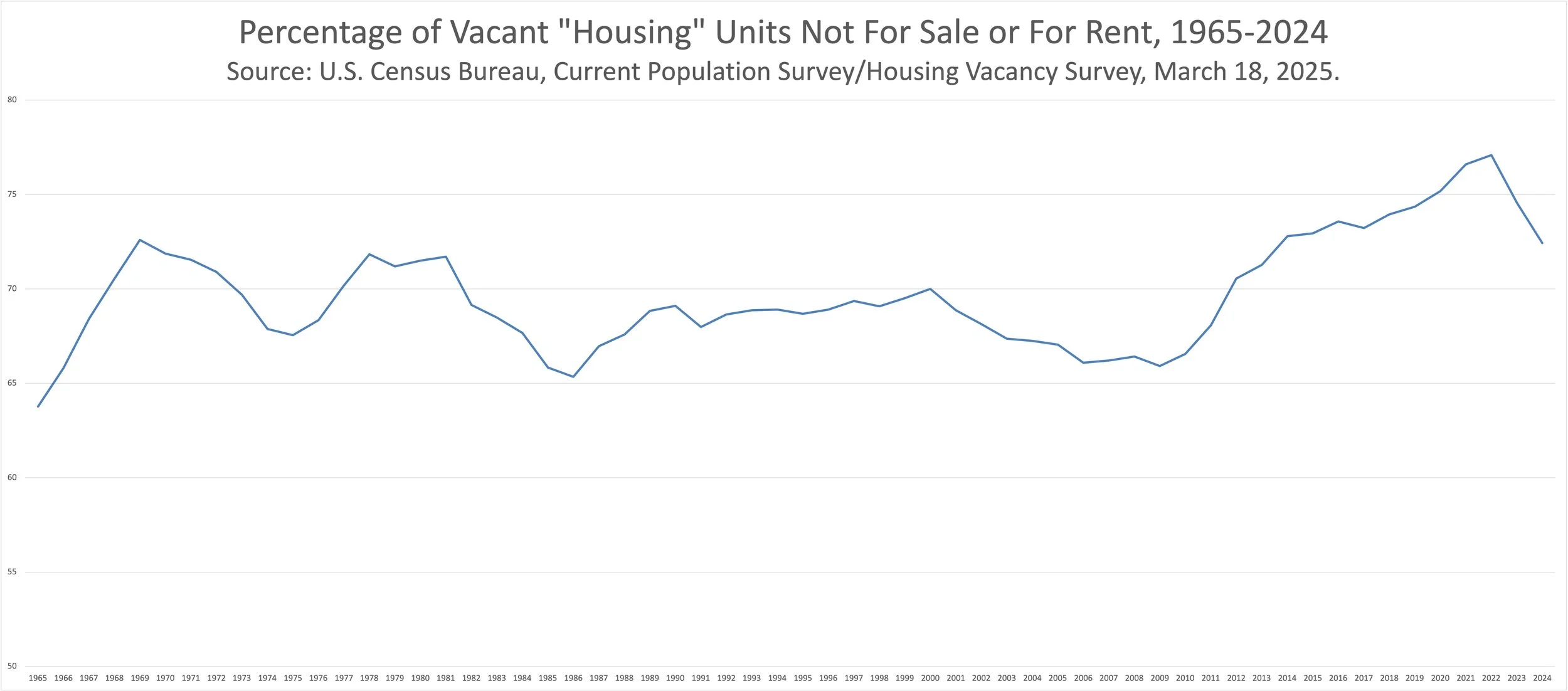
Percentage of Vacant “Housing” Units Not For Sale or For Rent, 1965-2024. Graph by the author.
If we leave the fundamental need for human shelter to the whims of “the market,” we will not meet the needs of working families. We have had 40 years of economic policies that have increased the gap between the wealthy and everyone else; this concentration of wealth at the top means that rich people have more money to spend on luxury second and third homes, fancy vacation chalets, and speculative investments, leading “the market” to increasingly produce “housing” for them, not for us. That is why the percentage of vacant units not for sale or rent has reached historic highs.
For these reasons, we need to be very skeptical of studies that rely on vacancy rates and focus on “market demand” instead of human need.
If there is surplus of housing, why is it so expensive?
As discussed above, one a reason housing is so expensive, despite the fact that there are more than enough units to house everyone who needs a home, is that rich people and corporations are hoarding units and “the market” builds primarily for them. Among other things, this means that in many places, such as in Austin, while housing production has outpaced population growth, these new units are too expensive for lower-income families to afford. While McClure and Schwartz’s analysis showed nearly 42,000 excess units in Austin, it showed a shortage of nearly 67,000 rental units affordable to households making below 30% of median income in our area (just 24,000 rental units affordable to 91,000 extremely low-income households). This is what housing scholars call a housing “mismatch”—not enough units matched to the income levels that exist in a market area.
This means that 67,000 extremely low-income households in the Austin area are occupying units in a tier above what they can truly afford.[1] This mismatch sets off a chain, pushing not-quite-so-low-income households upwards into housing units that are unaffordable to them, thus pushing, in turn, middle-income households into unaffordable housing, etc. The result is a lot of people in Austin living in housing that is unaffordable to them, leaving many households struggling to make ends meet.
People who advocate for land-use deregulation to allow new supply at the luxury end of the market claim that new market-rate housing will make all housing more affordable through the mechanism of “filtering.” Filtering is where older, cheaper units become available to lower-income families, as housing “filters” or trickles down to them when higher-earners vacate their units for newer ones and middle-income earners, in turn, move up into the vacated, formerly high-income units, etc. In theory, this sounds great, but estimates based on actual data show that it takes somewhere in the neighborhood of 50 years for “filtering” to reach extremely low-income households.[2] Filtering is not a realistic way to address the affordability crisis.[3]
Instead of relying on the bankrupt idea of trickle-down housing, a much more direct and immediate way of addressing the affordability crisis would be to provide an abundance of subsidized housing to low-income families at below-market rates. This way, lower-income residents would vacate their unaffordable market-rate housing, opening up those units to households who can afford them, thus alleviating the housing “mismatch” and bringing down rents for most households. In fact, there has recently been a surge in local governments across the country doing just that.[4]
The Politics of Distraction and Division
In fact, the modest production of subsidized housing for low-income households in the past couple years in Austin is likely a major reason why rents have moderated recently.[5] If as much energy and as many resources had been put into building support for more subsidized housing rather than deregulation and market-rate supply, we would be in a much better position to house more people at affordable levels today because this would help resolve the housing mismatch that is straining so many household budgets.
Since the early days of the New Deal, real estate industry organizations have fought tooth and nail to minimize or eliminate publicly subsidized housing because it eases demand on market-rate housing and brings down prices, thus eating into their profits. Today, the flood of reports coming from the very same industry representatives that claim that a “housing shortage” has been caused by too many land-use regulations is another attempt to undermine support for subsidized housing in favor of solutions that leave the human need for shelter up to the whims of the market, while obscuring the fact that “the market” caters to corporations and the wealthy who hoard unoccupied units while the rest of us struggle to pay our bills.
Furthermore, we need to recognize that the real estate and development industry’s strategy of blaming the high cost of housing on “barriers” to increasing supply also pits renters against modest-income homeowners, and younger generations against older ones, while the wealthy luxuriate in their multiple housing units and sit atop record levels of real estate assets that serve no positive social function. We’re busy fighting for scraps, calling each other “YIMBYs” and “NIMBYs,” while the real estate companies and developers run up their profits.
Well-meaning progressives have been sold a bill of goods by a cynical industry determined to exploit our human need for shelter to maximize their profits and extract wealth from our communities. The reality is that “the market” will not solve the housing crisis because it does not produce housing for extremely-low-income families—that’s the real “housing shortage”—thus distorting our housing market and leaving too many of us struggling to meet our needs.
Email me with comments or questions: rich@richforaustin.org
[1] Most scholars accept that an “affordable” level for housing is approximately 30% of household income. This theoretically leaves enough to cover other expenses, such as food, clothing, healthcare, education. When housing costs more than 30% of income, households typically have to forego other necessary expenses, missing meals, skipping medicine, not having adequate clothing, etc. Of course, some of those 67,000 extremely low-income households end up homeless because they cannot meet their needs in the current market.
[2] Miriam Zuk and Karen Chapple (2016) Housing Production, Filtering and Displacement; Untangling the Relationships. Berkeley, CA: University of California, Institute of Governmental Studies, Research Brief. https://www.urbandisplacement.org/wp-content/uploads/2021/08/udp_research_brief_052316.pdf.
[3] Filtering also doesn’t work because often the chain is broken by new households being formed or moving into the area. See Evan Mast (2019) The Effect of New Market-Rate Housing Construction on the Low-Income Housing Market." Policy Brief. Kalamazoo, MI: W.E. Upjohn Institute for Employment Research. https://doi.org/10.17848/pb2019-13.
[4] Christina Rosales, Tram Hoang, D’Ana Pennington, and Mia Loseff (2025) Housing for the People: How Local Governments are Building Social Housing Solutions for Public Good. PolicyLink https://www.policylink.org/resources/publication/housing-for-the-people. Ashwin Warrior (2025) States roll our revolving loan funds to accelerate housing production. Center For Public Enterprise. https://publicenterprise.org/states-roll-out-revolving-loan-funds-to-accelerate-housing-production/.
[5] Andrew Weber (2025) Austin leads the country in new affordable housing construction, study finds. February 18, 2025. KUT News. https://www.kut.org/housing/2025-02-18/austin-tx-affordable-housing-construction-study. In the KUT article, Andrew Weber uses the phrase “affordable housing” to indicate housing that is rented or sold at below-market prices to low-income households. These units are also called “income-restricted housing” to indicate that they are restricted to families that qualify based on their level of income. In most cases, these units are publicly subsidized through a combination of local, state, and federal funding, so I refer to income-restricted housing as “subsidized.” I do this because the phrase “affordable housing” today is often used to mean housing that is affordable to middle- and even upper-middle-income families. This confusion was deliberately created by the real estate and development industry to make us think that “the market” is the best way to serve the shelter needs of low-income families. By using the phrase “affordable housing” to refer to market-rate housing instead of subsidized, income-restricted housing, industry groups like Up For Growth or the Real Estate Council of Austin intentionally make it seem like they are building homes for the needy, rather than building investment vehicles and luxury vacation homes for the wealthy.